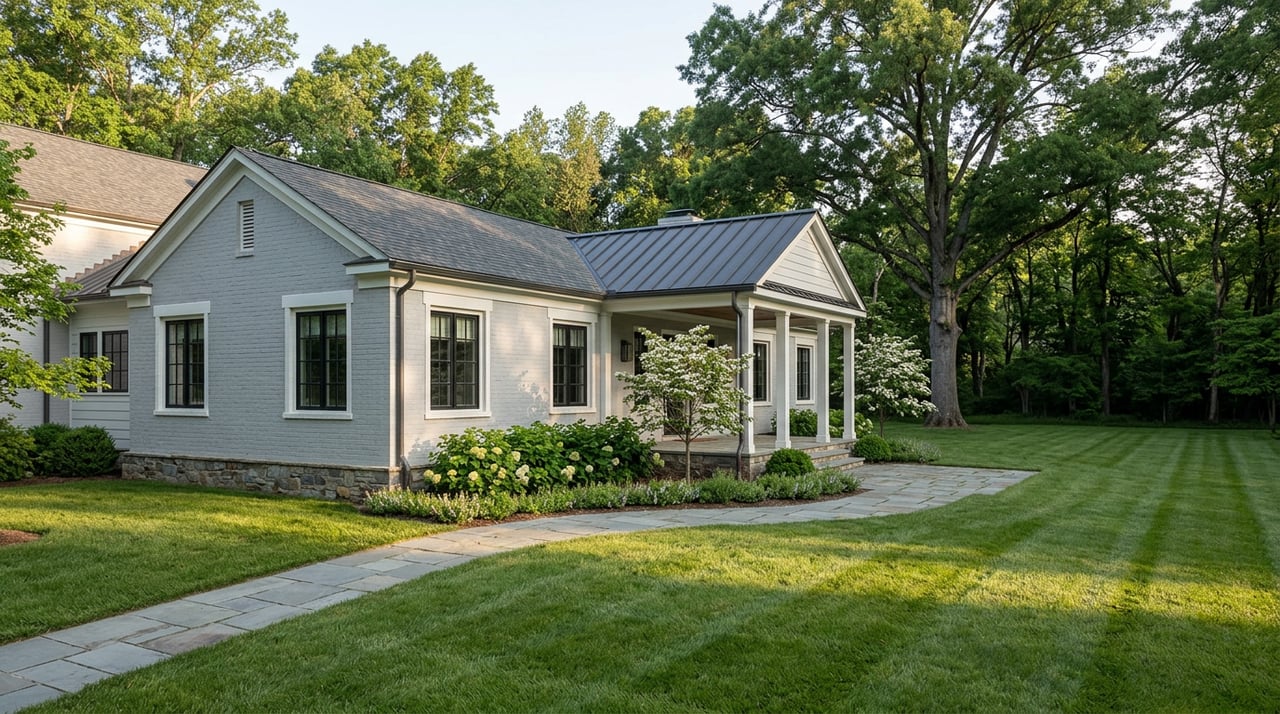
In Milton, the Real Limit on Your Addition Is Buried in the Yard
A homeowner on Freemanville Road calls a contractor about turning a bonus room into a fourth bedroom. The contractor sketches the framing, the homeowner picks tile, and everyone assumes the county's only question will be about setbacks or square footage. Then Fulton County Environmental Health gets involved, and the conversation changes entirely. It stops being about the room and starts being about a tank installed years ago, sized for a family that no longer lives there.
This is the part of a Milton renovation or acreage purchase that rarely makes it into the pitch deck from a builder or the walkthrough with an agent. Milton's appeal has always been room to breathe: large lots, mature trees, horse farms tucked against rolling terrain. Almost none of that acreage sits on public sewer. It sits on septic, and septic systems don't care about your floor plan. They care about bedrooms, and they were sized for a specific number of them a long time ago.
Pull Fulton County's own building permit application and the requirement is right there in the checklist: any project marked as a new building, an addition, or an alteration must show septic tank permit approval, with a direct instruction to contact Fulton County Environmental Health. It is not a suggestion buried in an ordinance nobody reads. It is a line item on the same form your contractor fills out before pulling the permit.
The reason is simple once you see it. Georgia's onsite sewage rules size a drain field and tank against bedroom count, not against the house's overall footprint. A three-bedroom home has a system engineered for three-bedroom flow. Add a fourth bedroom, a guest suite, or a detached structure with plumbing, and the county has to confirm the existing system can handle the added load before it will sign off on the framing you already picked out. If it can't, the upgrade happens before the addition does, not after.
That sequencing matters. A homeowner who budgets for cabinetry and windows but not for a possible septic expansion can find the real bottleneck isn't the contractor's schedule. It's a health department review that has nothing to do with how nice the addition looks on paper.
The soil under most of Fulton County is Piedmont clay, and clay drains slowly. Conventional gravity septic systems, the simplest and cheapest kind, work on only a minority of Piedmont lots. Fulton is named specifically among the Piedmont counties where alternative systems are common rather than exceptional, alongside Forsyth, Cherokee, Gwinnett, and Hall.
Here is what those alternatives run, based on 2026 industry cost guides:
| System type | Typical installed cost | Notes |
|---|---|---|
| Conventional gravity | $6,000 to $8,000 | Works on a minority of Piedmont clay sites |
| Mound | $10,000 to $20,000 | Most common Piedmont fix, raised drain field 2 to 4 feet |
| Aerobic treatment unit (ATU) | $10,000 to $20,000 | Requires an annual maintenance contract |
| Low-pressure pipe (LPP) | $8,000 to $14,000 | Mid-range option for marginal soils |
| Chamber | $7,000 to $12,000 | Good fit for moderate clay content |
For a Milton homeowner planning a renovation on a wooded, sloped, or creek-adjacent lot, that table is the real budget conversation. An addition that looked like a $60,000 project on paper can carry a five-figure septic contingency the drawings never mention.
The variability shows up differently across the city. Properties along the Hopewell Road corridor, in Birmingham, and out toward Bethany Bend and Freemanville Road tend to sit on larger, more sloped acreage where advanced treatment systems are already in place because of terrain and stream buffers. Crabapple and Deerfield lots, closer to the city center, sometimes carry smaller parcels where the same clay creates different but equally real constraints. The pattern holds across neighborhoods, but the specific fix rarely does.
The bedroom count that limits your renovation was decided years ago, by a permit filed under a different owner's name, sized for a different family's water use.
If you're buying raw acreage in Milton to build rather than renovating an existing home, the same soil issue arrives earlier and can be more expensive to discover late. Across Georgia, buyers routinely spend $30,000 to $100,000 on rural land only to learn afterward that the clay cannot support a conventional system and an alternative will run $15,000 to $25,000 more than expected. A pre-purchase soil evaluation, typically $300 to $500, is the fix, and it belongs in the contract as a contingency rather than an afterthought. If the evaluation comes back showing the land can't support a system you can afford, a well-written contingency lets you walk without losing earnest money.
For anyone comparing lots for a custom build in Milton, that soil evaluation is arguably more predictive of your final budget than the lot's asking price.
Georgia has no statewide law requiring a septic inspection before a home sale, and no Fulton-area jurisdiction has adopted a mandatory point-of-sale ordinance. That surprises a lot of buyers who assume something this consequential must be legally required. It isn't, at least not by the state or the county directly.
Lenders are a different story. FHA, VA, and most conventional mortgage underwriters require proof the septic system functions before closing, which means the inspection happens anyway in nearly every financed transaction even without a state mandate forcing it. The gold standard version is a Performance Evaluation Report from the county environmental health office, typically $400 to $600, built on a standardized form and treated as the benchmark document in Georgia real estate transactions. Private inspectors offer a comparable evaluation for $300 to $500. Either way, if the tank needs pumping to complete the assessment, expect another $237 to $375 on top.
The stakes for skipping this step are not abstract. A septic system that fails inspection or fails after closing can knock $10,000 to $30,000 off a home's value, and with an estimated 1.0 to 1.3 million Georgia homes running on septic statewide, this is not a rare edge case. It is a routine part of doing a deal correctly in a county like Fulton, where large-lot living is the norm rather than the exception.
Whether you're buying, selling, or planning a project on a home you already own in Milton, a few questions belong on the list before contracts or construction drawings move forward.
Does Milton require a septic inspection before I can sell my home? No state or Fulton-area ordinance mandates one, but nearly every financed buyer's lender will require proof of a functioning system before closing, so in practice an inspection happens in most transactions regardless.
I only want to add one bedroom. Does that really trigger a review? Bedroom count is the primary figure health departments use to size a septic system, so adding one changes the calculation. The county reviews existing capacity against the new count before signing off on the building permit for the addition.
Is a two-compartment tank a modern requirement or does my older Milton home need to comply? Georgia has required two-compartment tanks with effluent filters for new conventional systems installed since February 2000. Older systems installed before that date are typically grandfathered until a triggering event, such as a bedroom addition or system failure, requires an upgrade to current standards.
If you're weighing a Milton acreage purchase, planning an addition on land you already own, or trying to figure out what a lot's soil will actually let you build, this is exactly the kind of question worth asking before the offer or the drawings go final. Casey Schiltz works alongside a second-generation local builder on these calls every day, and can help you get the right people involved before a septic surprise becomes a budget problem. Schedule a consultation to talk through your specific lot, your renovation plans, or your search before you're locked into either.
Stay up to date on the latest real estate trends.



With over 15 years of experience in the real estate industry, Casey has built a reputation for delivering exceptional results for her clients.